ACTING CHAIRMAN ADDRESS
BY PHIL ASHLEE
Hello and welcome to this very special occasion — our model railway exhibition celebrating 200 years of the railway. What a milestone! Two centuries ago, the very first steam-powered railway services began to change the face of travel, commerce and industry forever. Today, we gather not only to honour that revolutionary past, but also to celebrate the enduring spirit of the railways — in full scale and miniature alike.
From George Stephenson's pioneering Stockton and Darlington Railway in 1825, to the high-speed marvels and heritage steam lines of today, railways have woven themselves into the fabric of nations, communities and childhood imaginations. And for those of us in the model railway world, that love for trains has found a second home — on tabletops, in garden tracks, on living room floors and in painstakingly detailed exhibitions like this one.
This isn't just about nostalgia or hobby; it's about craftsmanship, storytelling and engineering — the very same values that made the real railways possible in the first place. Every model here, whether it's a perfectly weathered freight car or a bustling station scene, reflects hours — often years — of dedication. It's a living tribute to 200 years of railway innovation and to the people who keep that legacy alive.
Let us take a moment to reflect on what we are celebrating: the power of connection. Railways brought distant towns together, opened up new frontiers, and quite literally changed the speed of life. Model railways, in their own way, continue to bring people together — young and old, beginner and expert, hobbyist and historian — all united by a shared fascination with movement, mechanics, and the stories these trains carry with them.
So whether you're here today as a seasoned collector, a curious visitor, or someone discovering the magic of railways for the first time, we welcome you. Explore, ask questions, marvel at the artistry, and let yourself be transported — back in time, forward in imagination, and side by side with generations of railway lovers.
Here's to 200 years of railways — and to many more years of dreaming, building, and running trains, no matter the scale.
Thank you, and enjoy the exhibition!
Our highly qualified experts will complete any task fast and reliably.

01 - NEUBURG 1913 & 2013 (HOm GAUGE).
EXHIBITOR JIM FINLAYSON
I was inspired to build these two layouts in order to capture a little bit of Switzerland and show how the area has evolved over time, a bit of time lapse modelling you might say.
Neuburg is a fictional RhB station seeking to portray the feel of the Grisons Canton, possibly the Albula Valley, by using models of actual buildings in the area and having a vertical component to the scenery. The track plan is based upon Begun but much modified to fit the space available – each layout being 2.4m x 1.2m.
The first layout is set in 1913 at the peak of the RhB steam era when the greatest variety of locomotives was in service. It was fairly straightforward to choose 2013 as the period for the second layout when trains were primarily electric loco hauled and multiple units were beginning to make an appearance.
The operating crew will be happy to talk to you about the changes over the period. Technically, the layouts have conventional softwood and ply baseboards. Scenery is aluminium mesh covered with ModRoc and where appropriate Heki rock foil. Buildings are mainly 3D printed, some using wood filament. Track is Peco HOm using DCC with RocRail software.
The layouts operate within a private WiFi network to allow remote control from tablets. Stock is predominantly Bemo with some STL, D & R and some scratch built / 3D printed.
We are very happy for anyone, kids included, interested in running the trains to have a go at operating these layouts.
2) ROWNTREE HALT (OO GAUGE) EXHIBITOR: JIM WHITEHEAD
Rowntree Halt depicts the Foss Islands branch in the 1950s up to 1960. We also run cameos of past special trains that ran past Rowntree Halt.

3) WOLFSTATT (HO GAUGE) EXHIBITOR: CRAIG & LEWIS CHARITY
Wolfstatt was conceived back in 2010 by Lewis and I out of a desire to create a model railway as a father and son project, as neither of us had any experience building a model railway we didn't really have any idea what we were letting ourselves in for. Construction took over 10 years to complete Wolfstatt to the stage presented to you today. Based on modern day Austria the layout takes its inspiration from the high Alpine mainline routes across the various mountain ranges in Austria.
This is a large layout which enables us to show a constant parade of full lenth trains passing by in an Alpine setting, traffic is modelled on actual trains to be seen on these routes over the last 10 years. A rich varied and colourful array of traffic can be seen representing the state railways of Austria, Italy, Germany and Switzerland to name a few together with some of the private operators. After visiting many exhibitions Lewis and I decided we wanted to create something different on the exhibition circuit which we feel we have achieved. We are a friendly bunch so please feel free to ask questions and enjoy your time viewing Wolfstatt.
4) JERSEY ROYAL (0O & HOf GAUGE) EXHIBITOR: JOHN FORSTER
This model was built during the lockdowns of 2020 and 2021. It is based on the large potato farms to be found in Lincolnshire but is not a model of any particular one.
These farms used temporary narrow gauge track laid from the main farm out to the fields where the potatoes were being harvested. The full narrow gauge Trains brought the potatoes back to the farm, in this case they are taken into a transshipment shed where they are loaded into sacks then taken away by standard gauge trains.
The train of empty wagons then emerges from the other end of the transshipment shed to return to the field for another load.
5) RIVER KWAI (HOm GAUGE) EXHIBITOR: JAMES SPENCE
The railway was built for the Japanese during the second world war by British and other allied troops including Dutch to help to move troops and supplies from Thailand into Burma.
It is said one soldier died for every sleeper laid giving it it’s name The Death Railway. The bridge was brought from Java by the Japanese to be used to cross the river
6) THE PLAYOUT (LEGO SCALE) EXHIBITOR: DARREN ROE
Welcome to The Playout. We are a twin oval 'tail chaser' style layout build entirely from lego bricks and designed to be operated by the public.
We have everything from steam to diesel and passenger to goods trains so if you are young or just young at heart, come along and have a drive of our trains.
If you have any questions feel free to have a chat with our friendly operators.

7) TAYLORMADE WASTE (OO GAUGE) EXHIBITOR: SHAUN TAYLOR
The layout is called Taylor Made Waste. It is an OO gauge modern image layout. The layout is a waste to energy plant loosely based on the site at Wilton where trains bring in full containers of waste to be turned into energy by incineration.
The loco brings in full containers to be tipped then pick up empties to take away for refilling. There is also a siding for locos to park up or store empty wagons.
8) RHOS Y BOL (OO GAUGE) EXHIBITOR: DAVE BROWN
Rhos y Bol is a real place on the Isle of Anglesey in North Wales. It translates to "Moor in the hollow" probably referring to the now defunct nearby copper mine .The area never had a railway that I know of.
I gave my layout this name in memory of my Mother who was brought up there.The layout is based on the Ffestiniog railway and features a double figure-of-eight and rear storage loops for four trains. Taking over a year to construct with a lot of hard work I hope you can feel the ambience of North Wales narrow gauge railways .
9) EAST GLASSON (OO GAUGE) EXHIBITOR: JOHN SWALES
The layout is called East Glasson Port Authority, and is a shunting puzzle-style layout set in the 1930s on the Lancashire Coast line, though it is a completely fictional location.
I’m working on installing various animated scenery elements such as opening gates, push button light effects in buildings, and hopefully, a working dock crane for visitors to operate.
10) KIRTLEY BRIDGE (O GAUGE) EXHIBITOR: BOB HORDERN
Kirtley Bridge is my first venture into 7mm scale and so far has taken about six years to build. Having lived and worked in the Yorkshire Dales for most of my adult life, and given my background in geology and geography, it was inevitable that the scenery and its railways would reflect this.
But let’s begin with some history and see how I used this to develop my layout. “In the Yorkshire Dales, in the closing years of the nineteenth century, local businessmen raised funds to build a light railway to serve their estates, farms, mills and quarries.
Trains would run up the valley through the village of Hebden to Kirtley Bridge. Local people, too, hoped to use the line to reach the nearby cities of the North and West Ridings of Yorkshire for work and travel.
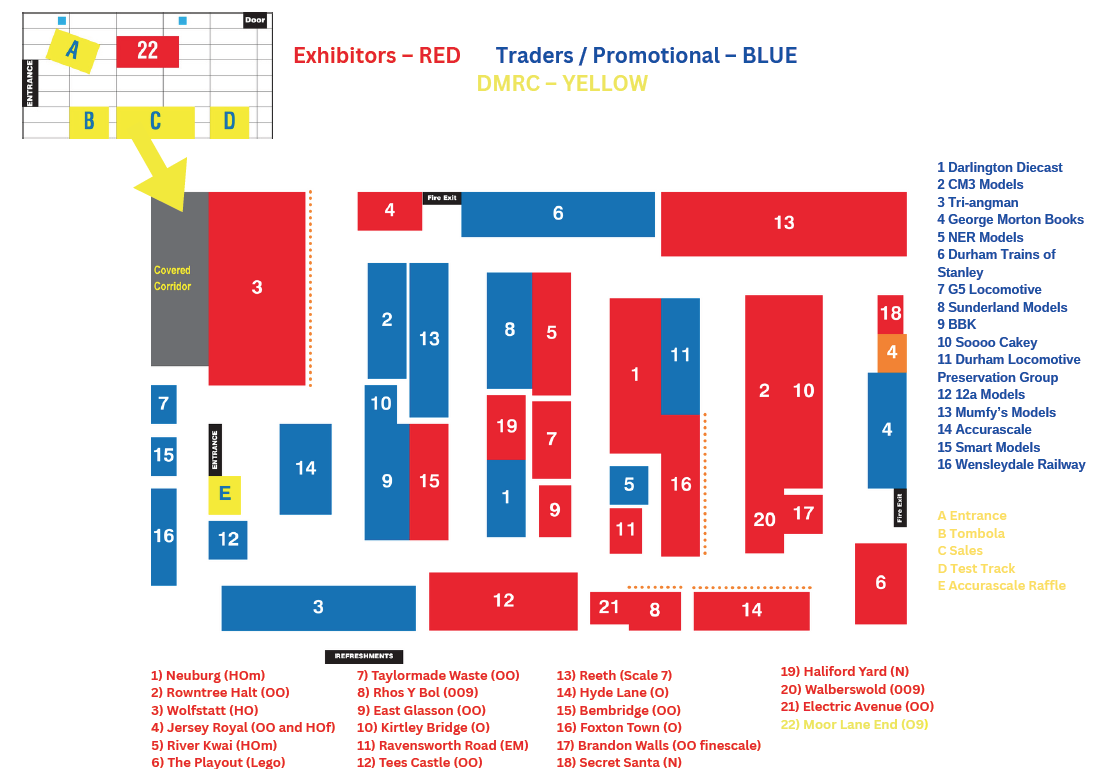
11). RAVENSWORTH ROAD (EM GAUGE) EXHIBITOR: PETER SHIELDS
Ravensworth Road is a small EM gauge layout inspired by the fuelling point and wagon repair facility at the east end of Tees Yard. It is set around 2018/19(ish) just before Covid hit this country and we all went into various forms of lockdown.
The name 'Ravensworth Road' comes from the street where I lived as a teenager in Sunderland - a very long time ago!
The locos are all ready to run, mainly from Bachmann, with wheels either replaced with EM gauge wheelsets or the RTR ones simply opened out to the relevant gauge. Some, like the Bachmann class 66 have additional details such as the cab rear view mirrors.
All are weathered to varying degrees based on photographs taken around the time the layout is based.

12) TEES CASTLE (OO GAUGE) EXHIBITOR: COLIN & RAY BATCHELOR
Tees Castle had been exhibited as an end to end layout since the early
1980’s, representing steam operations over the Stainmore line at Barnard Castle. The buildings are scale replicas surveyed from those existing on the station site following closure of the route in 1962 after one hundred and one years of service.
The Penna Lane team having acquired the layout in late 2024, has endeavoured to recreate the track plan including holding loops and goods yard at Barnard Castle Station, most of which had been left off due to space limitations on the original ‘lean’ layout.
It was also felt that the intensive operation of the late 1950’s could be best achieved by incorporating a continuous circuit served by separate directional fiddle yards with easier operator interfaces.
Minerals, together with the constant procession of coal, coke, part finished iron and steel products, were the lifeblood of the Stainmore route between County Durham and West Cumberland.
These were intertwined within scheduled passenger and general goods traffic serving the communities on and beyond the route. In addition excursions and special military traffic had to be catered for and the holding loops at the passing points of Stainmore Summit, Kirkby Stephen and Barnard Castle were fully utilised.
At ‘Barney’ the station had a single platform road serving both east and west bound services, with bay platforms at either end for those commencing and terminating in each direction.
We are looking forward to exhibiting the layout with DCC sound, representing traffic of the later 1950s era and hopefully showing the layout as its creator Ray Goad, his team and the later Darlington MRC team had intended.
13) REETH (SCALE 7) EXHIBITOR: SIMON CAYGILL
In the late 19th century and early 20th century there were fluctuations in the lead markets which caused a number of periods of increase and decrease in demand for the lead mined in England. During these times, the lead mines in North Yorkshire were in constant fluctuation.
During the early 20th century, the Eryholme-Richmond branch line had several Acts of Parliament passed allowing an extension to Reeth.
This layout represents one of those projects being completed.
With the Lead mining industry was the population increase in mid to upper Swaledale which required not only lead shipped out of the dale but goods to support the local populace coming in. Passenger traffic was added as well as farm produce – sheep and cattle movements to Darlington market. The layout has been built to Scale Seven standards that uses an accurate gauge and more prototypical wheel profile. All the track has been hand-built and uses servos to throw the points. The buildings are a mix of scratch built, or customised kits.
Rolling stock is a mix of kit built and ready to run with a wheel conversion.
14) HYDE LANE (O GAUGE) EXHIBITOR: NICK HUGHES
Having lived a stone’s throw from Healey Mills Yard, I have always had the idea of modelling a diesel depot. The yard and its depot had been closed for quite a while before the demolition team moved in to raise the office buildings and loco shed to the ground.
I managed to get some photos before it went and also found the quite a few shots of the inside of the shed on the internet. So, when my Dad suggested we build a new layout I thought “how about a small diesel depot?”
Using the Healey Mills shed as a starting point, albeit a shortened version, a few track plans were sketched out and a final one chosen.
15) BEMBRIDGE (OO GAUGE) EXHIBITOR: MARK PRETIOUS
Bembridge was the eastern most station on the Isle of Wight, located some two and three quarter miles north east of Brading Junction. The line opened in 1882 and was closed in 1953 due to declining traffic.
In the 1920s, with the introduction of the Adams O2 Class tanks the sector plate was increased in size from 16ft 5in to 25ft to accommodate the longer wheelbase engines. In 1935 the Southern Railway decided to make the line one train working so there was no need for signals.
The signal box is effectively a ground frame and was operated by the fireman to allow the engine to run round its train.
The line was mainly operated with the Beyer Peacock 2-4-0T, Terriers and later the O2s, which also included a push pull operation. During any quiet period of the day the duty engine would leave its train at Brading or Bembridge and perform shunting duties at St Helens-Quay.
16) FOXTON TOWN (O GAUGE) EXHIBITOR: DAVE FOXTON
A ficticious town in the North East circa 1950s to 1960s, representing a station terminal in which a number of steam and diesel locomotives and rolling stock move in and out of the station.
17) BRANDON WALLS (OO FINESCALE) EXHIBITOR: ALAN BLACKBURN
The model is based on a real lime kiln on a steep valley side not far from my Upper Weardale home. Built in the 1890s, the line did not last very long, so I have moved it's timeline into the 1930s.
The layout is my first attempt at a micro type of layout, being 4ft x 1ft. To add depth to a small layout, the baseboard is curved away from the viewer, with the scene rising from grass and trees to moorland, then into a bottom-lit backscene, where the sky colour can be changed to reflect different times of day.
18) SECRET SANTA (N GAUGE) EXHIBITOR: MARK FIELD
An impending move to the North East of England was fast approaching so all railway modelling items, etc. were heading for storage. There it stayed for a year whilst building work was carried out at our new home.
Around the summer of 2023 my “man cave” was completed. I was keen on getting back modelling and with Christmas approaching and a two-foot baseboard waiting for something to happen, “Secret Santa” was started.
Why I called it “Secret Santa”? A few of the items used in this layout are gifts from family. At Christmas we use the “Secret Santa” idea, we set a value and half we put towards a gift and half we donate to a charity that your “Secret Santa” nominates.
19) HALIFORD YARD (N GAUGE) EXHIBITOR: RICHARD PRATT
This fictitious location is a small yard set in West Yorkshire, based somewhere around Halifax/Bradford area. The time period is late 1990s / early 2000s and there are many different classes of locomotives to be seen before the invasion of EWS class 66s.
20) WALBERSWOLD (009 GAUGE) EXHIBITOR: PHIL ASHLEE
This layout loosely depicts the harbour branch on the Southwold Railway. Not quite authentic enough to call it Southwold. It is a fishing port, with sailing barges servicing the Suffolk coast to Ipswich and beyond to the Thames and London.
The buildings are typical of East Anglia and are either scratch built or kit-built. The majority of rolling stock is kit-built from the likes of Golden Arrow and Nineline, there being no ready to run in this scale. The layout is blessed with plethora of wild and domestic animals from the humble bumble bee to the lowly cow. Look for the butterfly and rat.
21) ELECTRIC AVENUE (00 GAUGE) EXHIBITOR: GORDON BULMER
Gateshead No. 14 and Sunderland No. 99 were produced from 3D printed bodies. Newcastle Nos. 96 and 102 were scratch-built from 2 Blackpool Dreadnought kits, Sunderland No.85 is from a white metal kit and Sunderland No.100 is a motorised OOC model. Sunderland No.51 water car was built from a modified Keil Kraft West Ham tram kit. Track is Peco code 75 flexitrack, the trams are powered from the overhead which is supported by Tramalan traction poles sleeved with two brass tubes to give a prototypical 3-section appearance. The tramway was built to run in automatic mode.
Electric Avenue has a working Oxford Diecast steam roller repairing a hole in the road and has a working Langley Models children’s playground behind the single row of houses. The childrens playground came from Langley Models and was modified so that the swings, see-saw and roundabout all work. The buildings were made from Metcalfe kits and have been fitted with internal lighting with street lighting added outside.
22) Moor End Lane Works (09 GAUGE) exhibitor: Darlington mrc
Moor End is a portrayal of a 1970’s 18 inch gauge mineral railway built by Tim Tincknell in 2012, the layout includes a works yard, loco shed, wagon repair shop and stores. Newer buildings include the portable cabin office to oversee that the work is on schedule and a corrugated iron loco shed. The track is Peco 009 ‘crazy’ type (used in 7mm to represent 18” gauge industrial railways) laid directly on the board and then ballasted with crushed slate and fine granite.
Controlled via DC using a Gaugemaster hand held unit and points operated by Peco solenoid motors. It was noticed on social media for sale down in Frome so Darlington Model Railway Club couldn't pass up the chance to own this fantastic layout, so a few of our members made the long journey down to bring it back to the North East so more people could have the pleasure of viewing it. Because there are no ready to run models currently available on the market for O9, the locomotives and rolling stock on the layout are either kit built or like the two Simplexes, 3D prints running on proprietary N gauge chassis.